BoLT logo

BoLT: A Benchmark to Democratize Black-box Optimization Research for Expensive LLM Tasks

1University of Washington  ·  2National University of Singapore  ·  3Singapore-MIT Alliance for Research and Technology
†Work done while at NUS.
Teaser figure
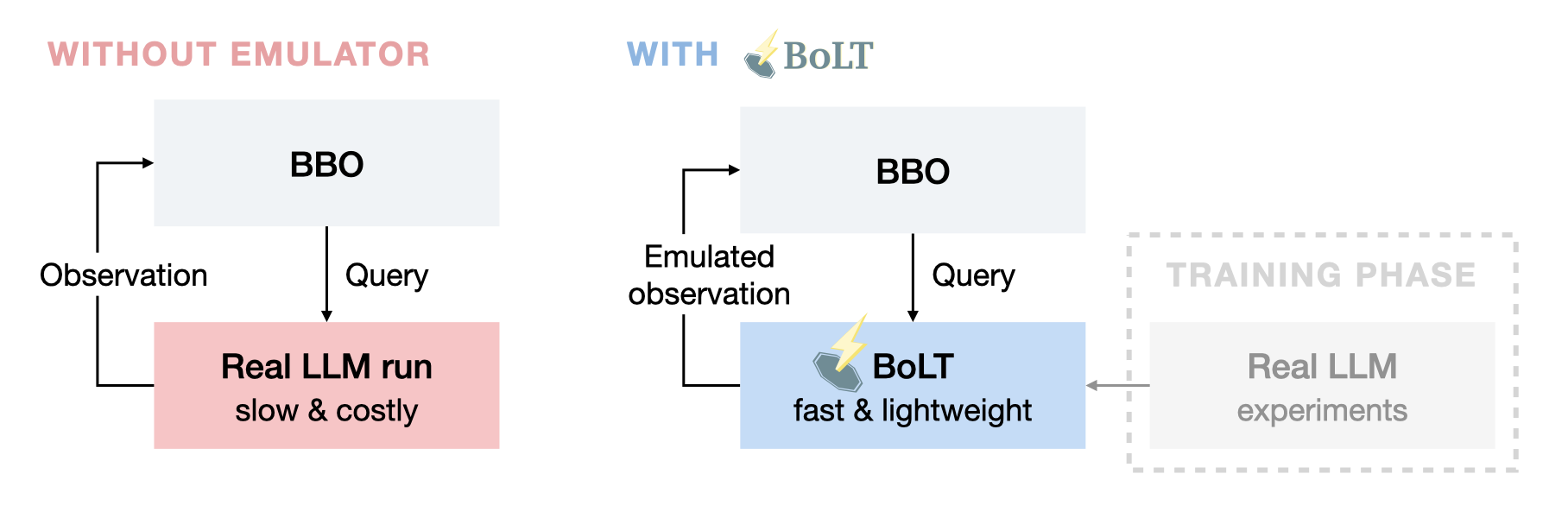
BoLT replaces slow LLM calls with a fast emulator. Without an emulator (left), each BBO query requires real LLM training and evaluation, which is slow, costly, and hard to reproduce. With BoLT (right), the BBO method queries an emulator (MLP) or tabular data built from real LLM experiments, returning observations almost instantly, at negligible cost, and reproducibly.

BoLT is the first BBO benchmark grounded in real LLM experiments, accessible without large-scale compute.

LLMs involve noisy, expensive, derivative-free decisions — hyperparameters, data mixtures, prompts, parallelism strategies — that black-box optimization (BBO) is built to handle. Yet most BBO research validates on synthetic functions that miss the real structure of LLM tasks. BoLT provides problems grounded in real LLM experiments, spanning multi-fidelity, multi-objective, heteroscedastic noise, high-dimensional, and constrained settings, all queryable through lightweight emulators or tabular data. BO methods generally outperform other baselines, but no single method wins across tasks, and methods remain far from optimal on some problems.
4 task families
13 LLM problems
30k+ real experiments
30+ methods benchmarked
Hyperparameter optimization MLP emulator
LoRA fine-tuning of Qwen3-4B/8B on OpenMathInstruct-2, evaluated on MATH-500.
ProblemDimChallenges
HPO7mixed variables
HPO-MF-Cont8mixed variables, continuous fidelity
HPO-MF-Disc8mixed variables, discrete fidelity
Data mixture optimization MLP emulator
Two-stage mixtures of TULU-3 instruction, math, and code data, evaluated on IFEval, MATH-500, and MBPP+.
ProblemDimChallenges
DMO6simplex constraint
DMO-MO6simplex constraint, multi-objective
DMO-Het6simplex constraint, heteroscedastic noise
Prompt optimization Tabular
Discrete search over 5,014 prompts, using Matryoshka embeddings at four truncation dimensions (128–768).
ProblemDimChallenges
PO-128/256/512/768128–768high-dimensional
Parallelism configuration optimization Tabular
Discrete search over parallelism configurations on 16–64 GPUs, maximizing training throughput without running out of memory.
ProblemDimChallenges
PCO-16/32/648black-box constraint

They approximate the real objective landscape at negligible query cost, validated against real runs on held-out configurations (Spearman ρ ≥ 0.76, R² ≥ 0.63).
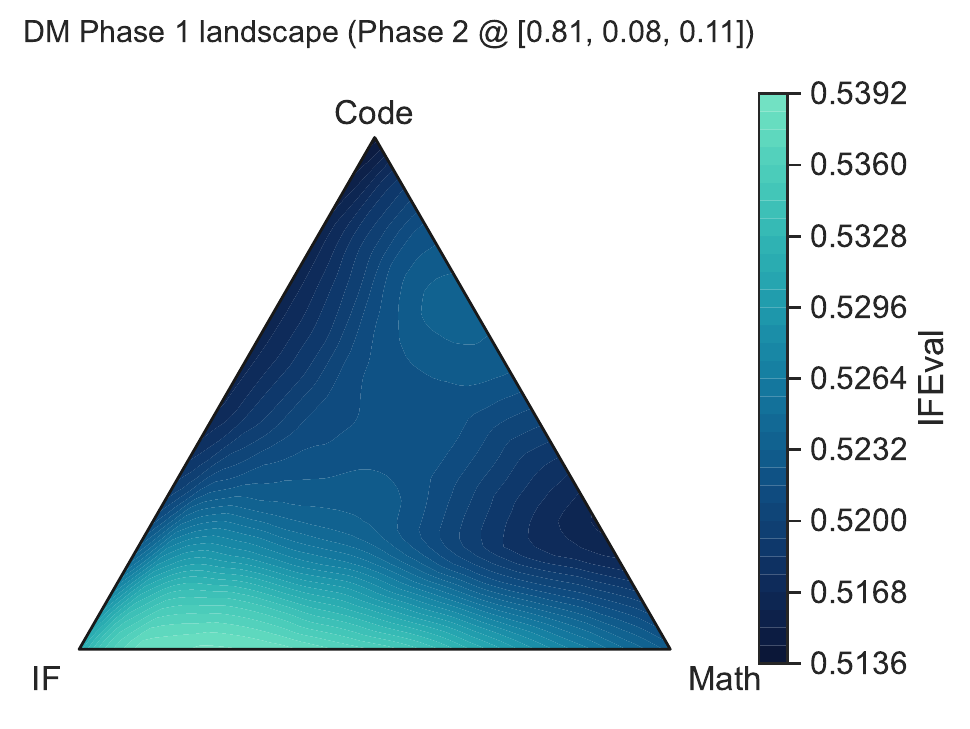
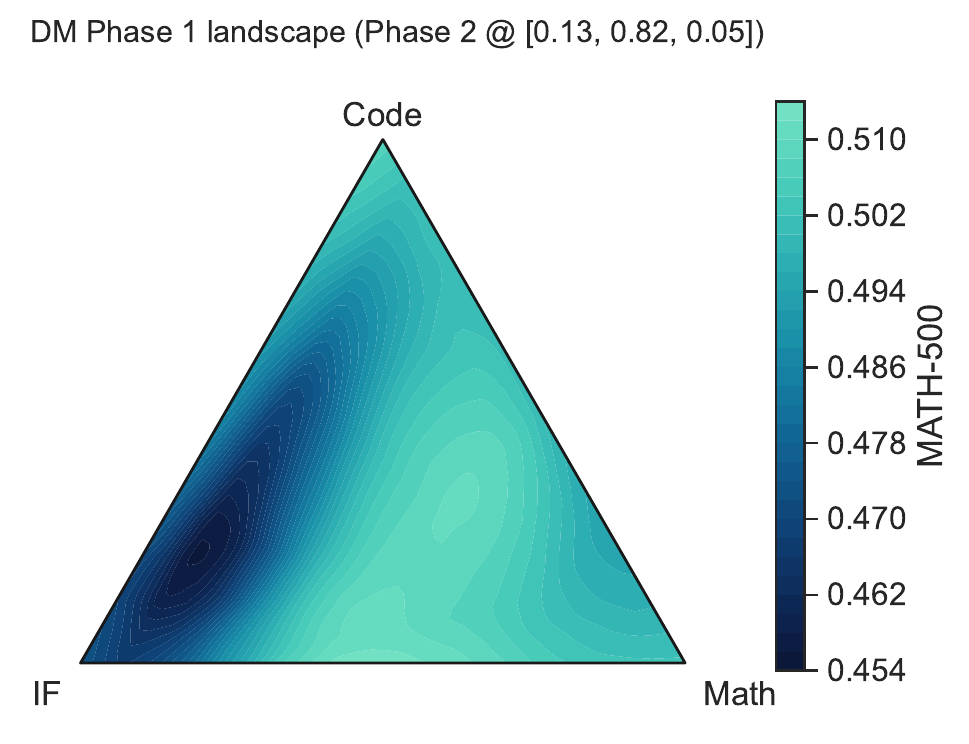
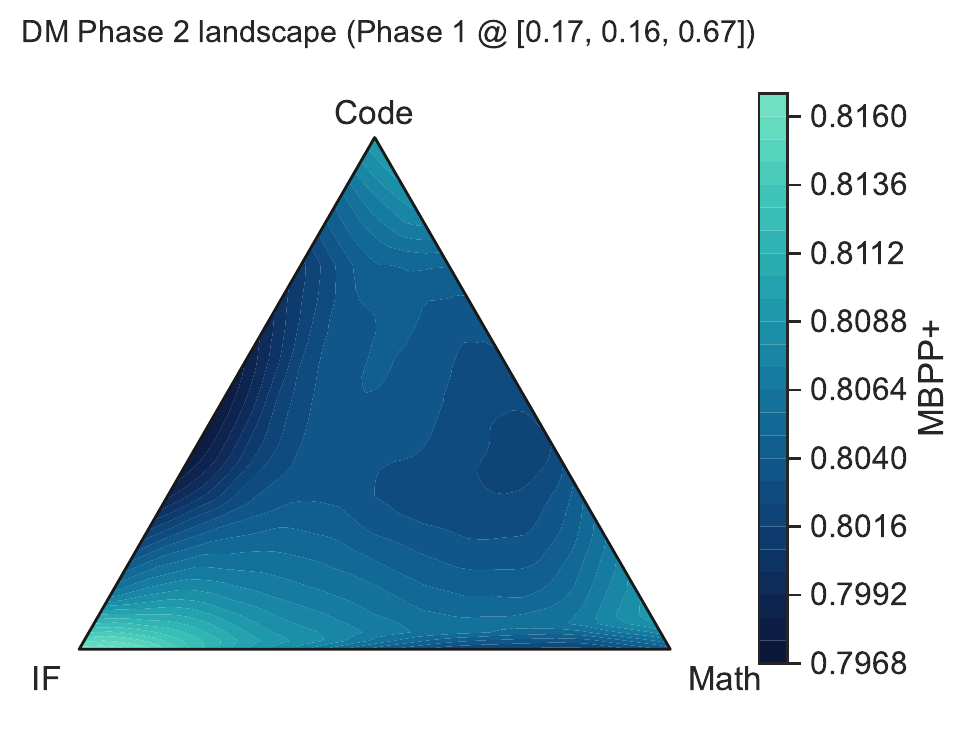
IFEval emulator landscape MATH-500 emulator landscape MBPP+ emulator landscape

2D slices of the DMO emulator landscape across instruction-following, math, and code data proportions. The varied terrain reflects real trade-offs in the underlying LLM experiments.

We benchmark 30+ Bayesian optimization (BO) and black-box methods across all 13 problems. Four key findings are presented here.
HPO
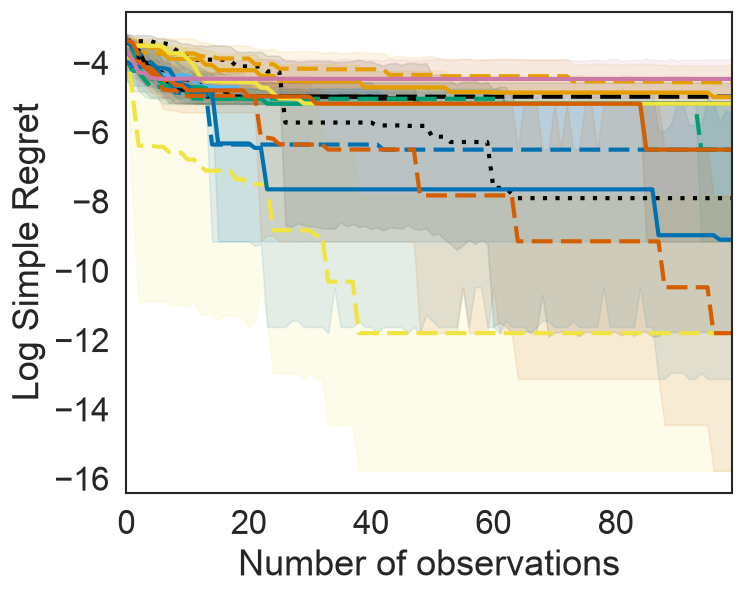
HPO legend HPO results
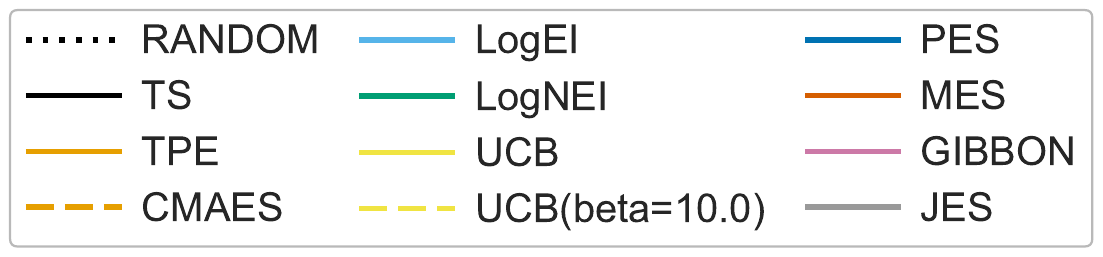
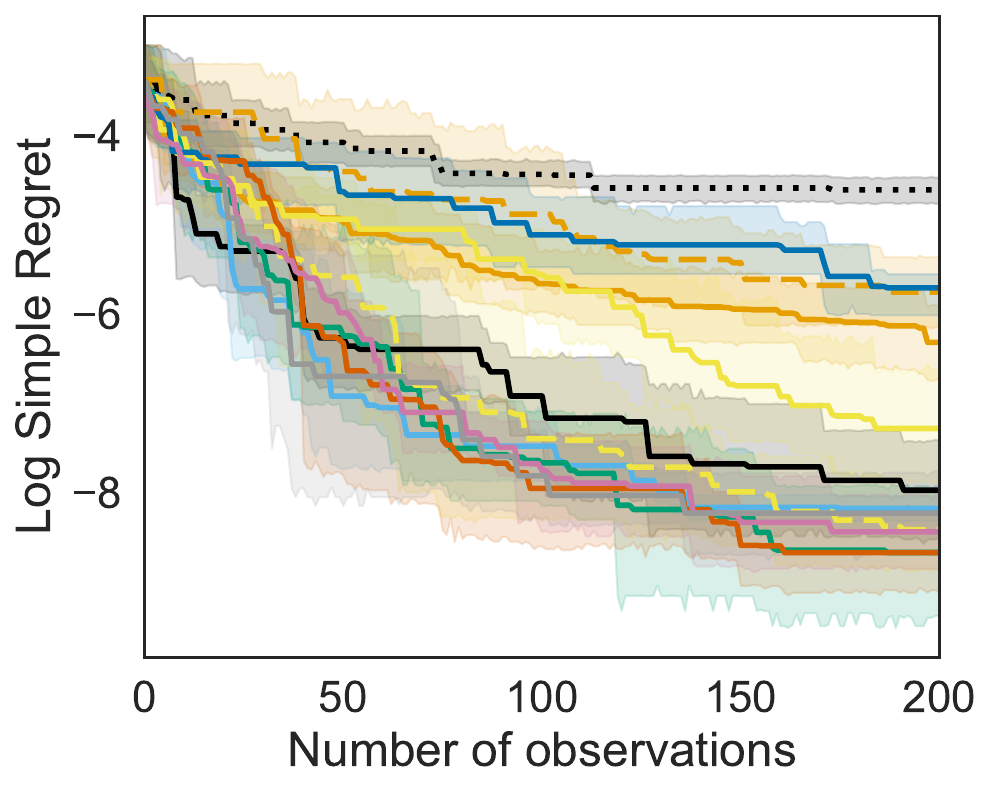
GP-based methods (GIBBON, UCB, LogEI) outperform HPO baselines (TPE, CMA-ES), and their compute overhead is negligible next to real LLM training costs.
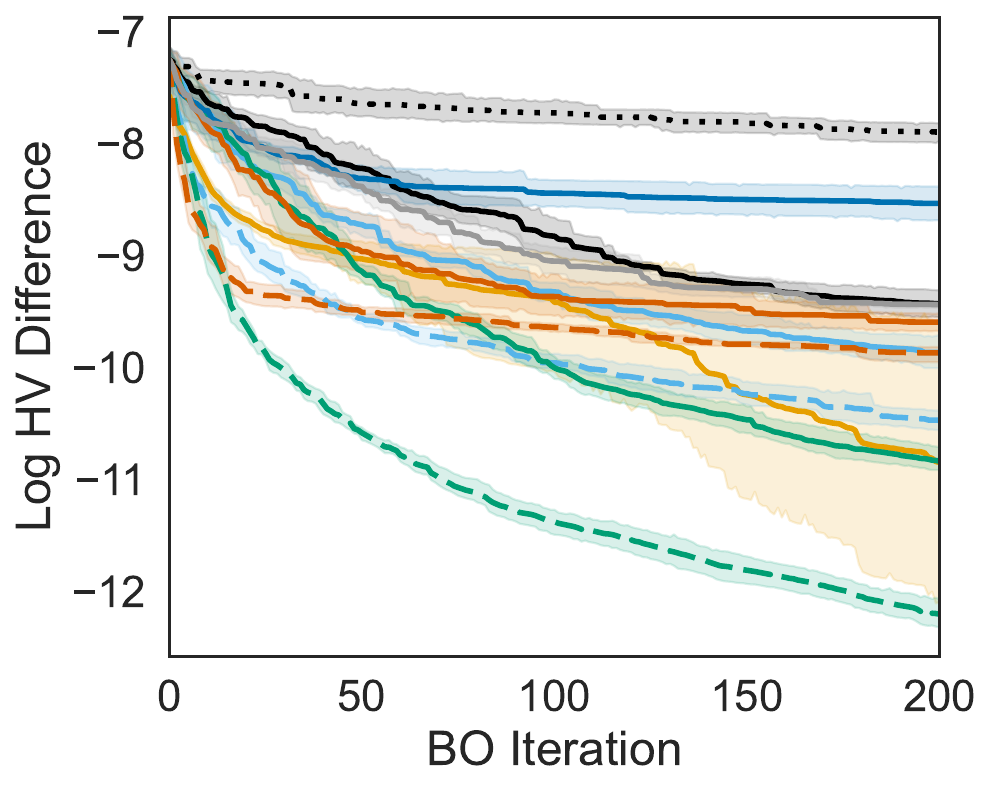
DMO-MO
DMO-MO legend DMO-MO results
NSGA-II leads early, but NEHVI overtakes it after ~100 iterations while using 50× fewer evaluations per iteration.
PO-768
PO-768 legend PO-768 results
Trust-region methods adapted for discrete candidate sets (dTuRBO, dBAxUS) are essential, approaching the optimum within 200 iterations with batching.
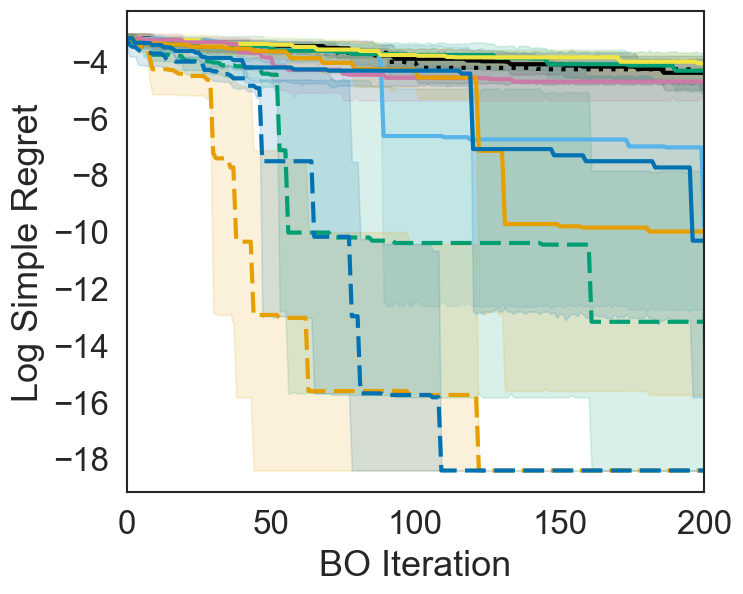
PCO-64
PCO-64 legend PCO-64 results
Near-optimal plateaus stall most methods behind random search, but parallelism priors help: UCB-C+prior finds the optimum in 5 of 10 seeds, up from 0.

BoLT API example

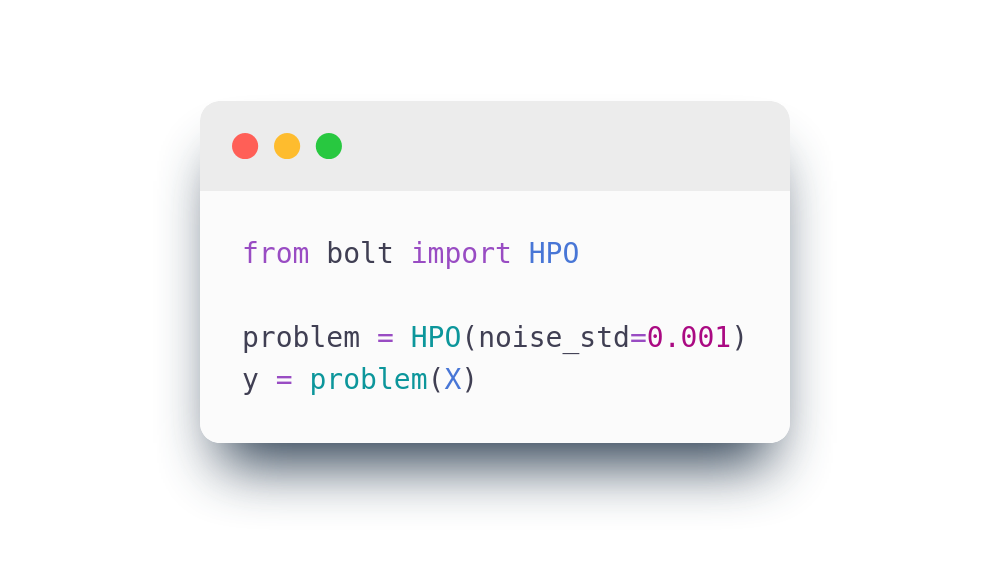
BoLT is built for BBO researchers. Every problem subclasses BoTorch’s BaseTestProblem, so your existing code plugs straight in. Emulator weights and tabular data are fetched automatically from HuggingFace on first use.

The benchmark is not limited to the 13 bundled problems. You can construct new optimization settings (contextual, etc.) using the public emulators or underlying data, without running any new LLM experiments.

Install the Python package, point your optimizer at a BoLT problem, and you have a reproducible, grounded evaluation. See the documentation to get started.

Citation

@article{chew2026bolt,
  title     = {BoLT: A Benchmark to Democratize Black-box Optimization Research for Expensive {LLM} Tasks},
  author    = {Chew, Ruth Wan Theng and Chen, Zhiliang and Hemachandra, Apivich and Low, Bryan Kian Hsiang},
  journal   = {arXiv preprint arXiv:2605.17000},
  year      = {2026}
}